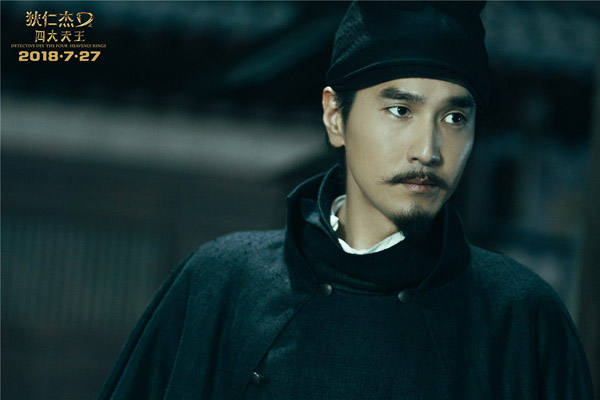
Detective Dee: The Four Heavenly Kings (Film)
Introduction
Detective Dee: The Four Heavenly Kings is the third installment in the Detective Dee film series, directed by renowned filmmaker Tsui Hark. Known for his mastery in blending martial arts with fantasy elements, Tsui Hark presents a visually captivating narrative set in 7th-century China. The film stars actor Mark Chao, who reprises his role as the titular detective, Di Renjie, alongside actors Feng Shaofeng and Lin Gengxin. The female protagonist is portrayed by Ma Sichun, a new addition to the series.
Plot Summary
The plot unfolds as Tang Emperor Li Zhi bestows upon Di Renjie the dragon-taming mace, symbolizing supreme supervisory power. Empress Wu Zetian, perceiving this as a threat to her own ambitions, orchestrates a plot to retrieve the mace. She enlists her top aide and a cohort of five sorcerers, leading to a gripping conspiracy involving an exiled rebel force from India aiming to overthrow the Tang empire. The film intricately weaves elements of mystery, action, and supernatural phenomena, showcasing Tsui Hark’s signature style of merging historical narratives with fantastical elements.
Characters
Di Renjie (Mark Chao): The astute detective serving under Emperor Li Zhi, renowned for his intelligence and problem-solving skills.
Empress Wu Zetian (Carina Lau): Envious of Di Renjie, she is set on removing him as a nuisance, leading to the assembly of a powerful team to seize the dragon-taming mace, sparking a series of grave crises.
Feng Shaofeng: Portrays the empress’s top aide, embroiled in the empress’s schemes.
Lin Gengxin: Plays a doctor, contributing to the film's intricate plot developments.
Ma Sichun: A skilled swordswoman, adding a new dimension to the film's character dynamics.
Ethan Juan: Cast as a Buddhist monk, wielding mystical powers to aid in resolving the central crisis.
Production and Visual Style
Produced by Huayi Brothers and CKF Pictures, Detective Dee: The Four Heavenly Kings exemplifies Tsui Hark's commitment to high-quality visual storytelling. The film continues the visual style established in its predecessors, Detective Dee and the Mystery of the Phantom Flame (2010) and Young Detective Dee: Rise of the Sea Dragon (2013). Tsui Hark is celebrated for his innovative use of special effects, creating a cinematic experience that rivals international standards, particularly Hollywood productions.
Themes and Inspirations
Tsui Hark’s film delves into themes of power, ambition, and the tension between reality and illusion. Drawing inspiration from unexplainable mysteries of ancient times, the film showcases the director's fascination with supernatural elements, portraying monsters and magical creatures that symbolize the darker aspects of humanity. The narrative challenges Detective Dee not only with solving crimes but also navigating the perilous political landscape orchestrated by Empress Wu.
Market Reception and Challenges
Upon its release, Detective Dee: The Four Heavenly Kings received a mix of praise and critique, reflecting the evolving tastes of the Chinese cinema audience. As part of one of China's most successful film franchises, the film was highly anticipated and managed to capture the attention of both domestic and international audiences. The visual spectacle, synonymous with Tsui Hark's directorial style, contributed significantly to the film's allure, drawing viewers eager for a continuation of the visually rich narratives established in the previous installments.
However, the film also faced significant challenges. The rapidly changing Chinese film market, characterized by an annual production of nearly 800 feature-length films, presented an environment where only a minor percentage of films achieve profitability. This competitive backdrop meant that despite the film's established fanbase and franchise success, it had to contend with a multitude of diverse viewing options available to a discerning audience. The domestic audience's growing pickiness posed another challenge, as viewers increasingly sought innovative and engaging stories amidst the cinematic abundance.








